
Personal life and work life may seem separate on the outside, but on the inside, you operate in the same core ways, whatever the environment. How you do one thing is how you do EVERYTHING; whether it’s life, work, or relationships.
In reality, you’re not a separate person at work and at home, even if it might seem like that. It depends on what is emotionally activated in you, but ultimately the default, unconscious responses will surface in any situation if re-activated.
An example might be, if you were bullied at school (I was) your survival response at the time might have been to hide, to make yourself small (my response), to keep quiet, to fight back (often striking out first and becoming the bully), to become sick to miss school. That response pattern comes with us through life, like a piece of heavy luggage, and in the face of a similar danger (trigger) we default to our survival response, even though the original trauma might have been more than 20 years earlier. Anything that feels similar seems like a threat. I often describe it to clients as being like a metaphorical smoke alarm. The smoke alarm in the kitchen goes off because the toaster is burning the toast. The next time a piece of bread goes anywhere near the toaster, the smoke alarm goes off. It remembers what happened last time and doesn’t want that to happen again. It becomes overly sensitised as a survival / protection response.
There are so many ways to respond to traumatic events, but all of them are based in survival. Our responses to trauma aren’t made from a conscious choice, they’re an automatic, involuntary survival mechanism, not a consciously chosen behaviour. When you feel threatened, the brain’s survival instinct triggers instinctive fight, flight, freeze, or fawn reactions to keep you safe, bypassing rational thought. These reactions are rooted in the nervous system and triggered by perceived danger. As we go through life, any time for example the ‘bully’ behaviour is present we automatically respond, such as making ourselves small, not speaking up. Bullying behaviours cause us to respond without thinking. It’s ingrained. We take these patterns into everything we do. Often experiencing cycles of behaviours – always cheated on or cheating on others, being bullied, manipulated, or trying to control others, striking out first (aggression) before we are struck. The pattern is still running until the nervous system is calmed, through therapeutic support and processing of the original wound. When we’re an adult and encounter the feel of the old wound it can trigger the same intensity of feelings as if we were still that child, as if what happened back then is happening now. And we deal with it in the same way, fight, flight, freeze, fawn. It might cause us to leave a job we love because of a bully, or make decisions based on self-protection, not logical thought.
Another example might be a team leader who likes to be in control (or that might be you!) and not delegate enough responsibility to their team. Fear of loss of control might be at the root of this behaviour, but the team can perceive it as not trusting them to do the job properly. This creates misunderstanding and often burnout for the person holding all the plates. This can show up in relationships too, one partner ‘controls’ all the finances, or makes the big decisions. The other may not challenge that behaviour for fear of their response because the response is what they are trying to avoid – such as anger, being belittled, put down, or verbally or physically pushed back on in some way, possibly violently. It’s easier to say nothing because the early memories of speaking up went badly, perhaps a physical beating or the fury of a parent. Why would they repeat that? Like the smoke alarm, their radar is on high alert to ‘not go there’, to avoid the feelings. It explains why people stay in unhealthy relationships for longer than they want to, a part of them knows it’s unhealthy, but another part is paralysed by the fear of confronting their partner, or they may fear being alone. This often leads to connection over safety. Keeping ourselves safe, physically, or psychologically, can be outweighed by keeping the ‘other’ happy.
Everything in life to date that has shaped your experiences, choices, and decisions runs like a script in the background, some scripts more prominent than others, and without awareness of them it’s hard to choose a different response or make different decisions.
Your unconscious patterns, beliefs, and automatic responses come with you everywhere. They are embedded in how you interact with the world and inform many of your choices.
Mostly these default behaviours begin in childhood, which is why many therapists will explore your early years to see what beliefs and behaviours have taken root in response to what has happened to you.
We all develop survival responses to fear and hurt and abandonment to protect ourselves from physical danger or emotional overwhelm, or to stop feeling uncomfortable feelings.
When your behaviours are outside of your conscious control, they persist. It isn’t always necessary to dig into the past because the past, if unresolved, is still alive in the way you respond and behave in the present. It is like a thread that shows up on the surface and when it’s gently pulled and eased out and untangled, it reveals what lies beneath waiting to be healed.
For many people, the idea of therapy can feel too overwhelming or just something they are not wanting to do. They fear revisiting painful memories and feelings, or the process taking too long to feel better.
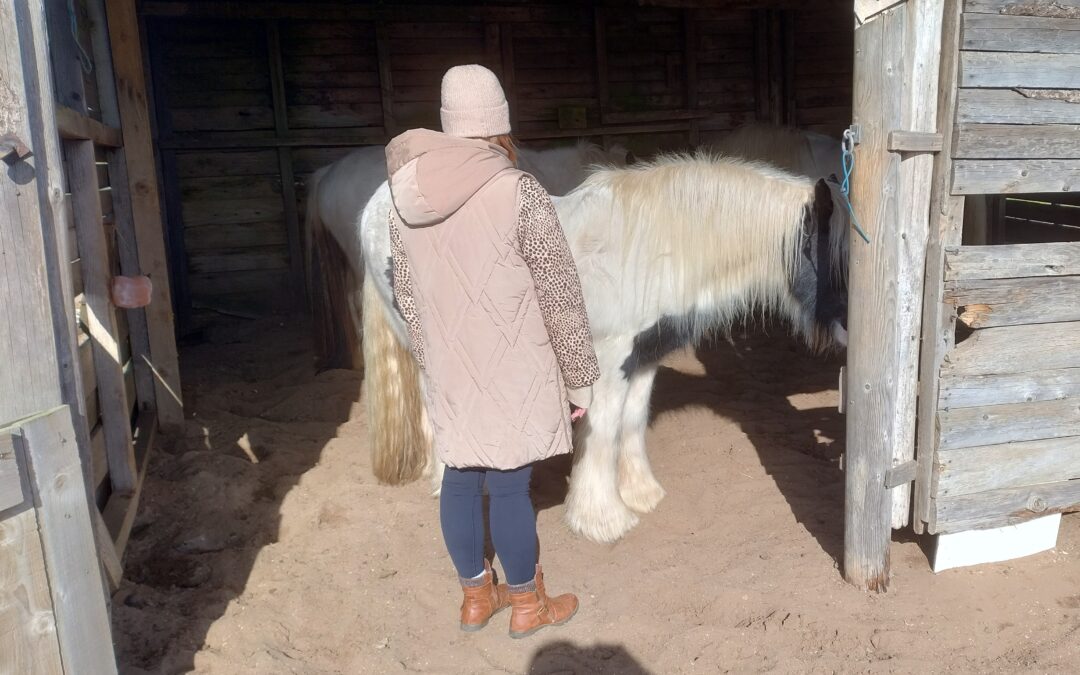
Bringing horses into the room, so to speak, changes the therapeutic environment. It can make the therapy space more accessible, feel less confronting, less restricting as it’s out in the open air in nature. The presence of the horses has a huge appeal too and the desire to connect with them can overcome fear of revisiting past wounds. Working with horses therapeutically is out with the traditional approach and this can make it much more accessible for people who feel resistant to traditional therapy.
Spending time with horses can reconnect us with parts of ourselves that have been buried under conditioning, people-pleasing, fear, trauma, limiting beliefs, and the expectations of others. Their response to you gives you immediate non-judgemental, non-verbal feedback and throws light on core patterns of behaviour which you might not have been aware of. As mentioned before, these behavioural patterns don’t just show up in the field, they run like a script through your life, affecting your choices, relationships, and life path. The key to healing is bringing these behaviours into your conscious awareness, so you can begin to change and clear old patterns and experience that change reflected back, not just in relationship with the horses, but in your life.
The beauty of this instant feedback is that through your connection with the horses, you can learn to be consciously aware of your inner reality and see how that affects the world around you. You will be able to experience and embody the effect of making a conscious shift in your thoughts and emotions and seeing that shift instantly reflected back to you by the change in the horse. This is such a powerful learning, to experience how you can change your world from the inside and see immediate and positive results.
During sessions with the horses, I often witness people make profound shifts. They reconnect with themselves. They rediscover parts of who they are that had been lost or forgotten. They become aware of unconscious patterns, limiting beliefs, and what it truly means to be present.
In the words of one of my clients:
“The horses have helped me access deep parts of myself I didn’t even know existed“